Rights, Justice & Action for India’s Women Farmers
7th Mar 2026
Read
- Share With Friend & Family
-

-

-

-

-

-

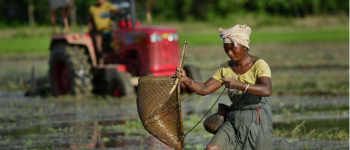
TABLE OF CONTENTS
- Why in News
- Structural Exclusion of Women in Agriculture
- Consequences of Exclusion
- Limitations of Existing Policies
- Way Forward
- Conclusion
Why in News
On International Women's Day (March 8, 2026), the M.S. Swaminathan Research Foundation (MSSRF) and the World Food Programme (WFP) highlighted the persistent structural exclusion of women farmers in India's agri-food systems. The issue gains greater importance as 2026 has been declared the International Year of the Woman Farmer by the United Nations.
Despite legal reforms such as equal inheritance rights under the Hindu Succession (Amendment) Act, 2005, women farmers still face limited land ownership, recognition, and institutional support in India.
| Background Women make up about 42% of India's agricultural labour force and 60-80% in some states, yet their role remains largely invisible in official data and policies. With rising male out-migration, the feminisation of agriculture is increasing, as women take greater responsibility for cultivation and food security without equal rights or resources. The National Policy for Farmers (2007) defines a farmer mainly based on land ownership, excluding many landless women tenants, sharecroppers, and forest-dependent women. As a result, many women are denied access to credit, crop insurance, extension services, and government schemes. |
Structural Exclusion of Women in Agriculture
1. Land Ownership and Legal Status
- Land concentration in men's names: Despite the Hindu Succession (Amendment) Act 2005 granting daughters equal inheritance rights, land and property in most rural households continue to be registered in men's names due to patrilineal social norms.
- Barriers to land records: Social customs, limited legal awareness, administrative hurdles, and patrilineal inheritance practices prevent women's names from appearing in land records even when they actively cultivate the land.
- No legal farmer status: Women who manage cultivation, deal with labourers and input dealers, and bear production risks lack legal recognition as 'farmers' due to the absence of land titles in their names.
2. Exclusion from Institutional Support
- Credit exclusion: Without land titles — the primary collateral for institutional credit — women are excluded from formal agricultural loans and Kisan Credit Card (KCC) facilities.
- Scheme exclusion: PM-KISAN, crop insurance under PMFBY, irrigation schemes, and climate-resilient technology programmes are overwhelmingly inaccessible to women without land ownership records.
- Extension services gap: Agricultural extension workers predominantly interact with male farmers, leaving women with limited access to improved seeds, farming techniques, and market information.
Consequences of Exclusion
Agriculture, Nutrition & Health
- Feminisation without empowerment: As men migrate to urban centres, women shoulder full agricultural responsibility without receiving corresponding rights, assets, or decision-making power.
- Drudgery and health burden: Resource-poor women face heavy workloads with minimal drudgery-reduction technologies, leading to serious health issues and micronutrient deficiencies, especially during peak agricultural seasons.
- Malnutrition and anaemia: India's persistently high anaemia rates among women of reproductive age (over 57% as per NFHS-5) are directly linked to their workload, dietary deprivation, and exclusion from nutritional programmes.
- Intergenerational consequences: Maternal undernutrition contributes to low birth weight, infant stunting, and impaired cognitive development, entrenching cycles of poverty and poor health across generations.
- Low dietary diversity: Despite women's central role in food production, rural diets remain cereal-heavy with poor diversity of pulses, fruits, vegetables, and animal-source foods.
Limitations of Existing Policies
India's food security architecture, anchored in the National Food Security Act (NFSA) 2013, guarantees subsidised cereals, supplementary nutrition through ICDS/Anganwadis, and maternity entitlements. However, several structural gaps persist:
- Cereal-centric PDS: The Public Distribution System remains heavily focused on rice and wheat, with uneven and insufficient inclusion of pulses, millets, and nutrient-dense foods critical for women's nutrition.
- Overburdened frontline workers: ASHA workers and Anganwadi workers carry excessive responsibilities, diluting programme quality and reducing community awareness about nutrition entitlements.
- Digitalisation paradox: While digital systems improve efficiency, they risk excluding women who lack connectivity, documentation, or digital literacy, limiting their ability to access benefits such as DBT transfers.
- Uneven implementation: Some states have introduced millets and fortified staples, but women's nutrition outcomes remain uneven, and anaemia reduction targets remain far from achieved.
Way Forward
Recommendations by M.S. Swaminathan Research Foundation (MSSRF) and the World Food Programme (WFP)
- Redefine 'farmer' in policy: Revise the National Policy for Farmers to define farmers based on agricultural activities rather than land ownership, recognising women tenants, sharecroppers, labourers, and forest gatherers.
- Gender-disaggregated data: Collect and publish gender-disaggregated agricultural data to make women's contributions visible and inform targeted policy interventions.
- Strengthen land rights: Implement equal inheritance laws effectively, promote joint spousal land titling, and introduce incentives for registering agricultural land in women's names.
- Women in resource governance: Strengthen women's roles in managing common lands, water bodies, and forest resources; use collective platforms like SHGs and FPOs to amplify bargaining power.
- Nutrition-sensitive food systems: Align public procurement and PDS with nutrition goals — expand distribution of millets, pulses, and vegetables through Anganwadis, school meals, and ration shops.
- Community nutrition initiatives: Promote kitchen gardens, women's seed banks, and local food planning to strengthen dietary diversity and women's agency in agri-food systems.
- Technology and extension access: Ensure women's access to labour-saving agricultural tools, gender-sensitive extension services, and digital market platforms to reduce drudgery and improve productivity.
Conclusion
The invisibility of women farmers in India's legal and policy systems is not just a gender issue but a development challenge. When women who produce food lack access to land, credit, and support, it affects households, communities, and future generations.
Empowering women farmers through legal recognition, asset ownership, and better support systems is essential for food security, reducing malnutrition, and building climate-resilient agriculture.
As 2026 is observed as the International Year of the Woman Farmer, the focus must shift from symbolic recognition to real structural change, ensuring that the women who feed India are supported and empowered.
UPSC Syllabus- GS Paper I: Role of Women and Women's Organisation | GS Paper III: Agriculture, Food Security & Land Reforms in India.
Source- TH

Author: Lemo
Lemo is the founder of Epoch IAS - a UPSC platform built not in classrooms, but at 2 AM over black coffee. He writes notes that are sharp, syllabus-ahead, and made for aspirants who are serious about cracking it. No fluff. Just focus.
Feel free to use images in our website by simply providing a source link to the page they are taken from.
-- Epoch IAS
Explore By Category
Latest Posts
 18th May 2026
![[Download PDF] Union Budget 2026–27 Summary](/storage/blog/small/download-pdf-union-budget-2026-27-summary.jpg) 30th Apr 2026
30th Apr 2026
 20th Mar 2026
 19th Mar 2026
 19th Mar 2026
-development-scheme.jpg) 19th Mar 2026
19th Mar 2026
 19th Mar 2026
 18th Mar 2026
 18th Mar 2026
 18th Mar 2026
 17th Mar 2026
 17th Mar 2026
 17th Mar 2026
 17th Mar 2026
 17th Mar 2026
Share views on Rights, Justice & Action for India’s Women Farmers
Please keep your views respectful and not include any anchors, promotional content or obscene words in them. Such comments will be definitely removed and your IP be blocked for future purpose.