Israel-US Strike on Iran: How It Threatens the Strait of Hormuz and India's Energy Security
28th Feb 2026
Read
- Share With Friend & Family
-

-

-

-

-

-

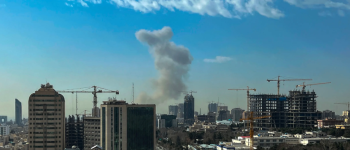
TABLE OF CONTENTS
- The Strait of Hormuz - A Critical Global Chokepoint
- Oil Price Scenarios — What Lies Ahead?
- India's Strategic Concerns
- Way Forward
Why in News- On 28 February 2026, Israel and the United States launched coordinated military strikes across Iran, marking a significant escalation in the long-running geopolitical standoff over Tehran's nuclear ambitions. The strikes followed months of unsuccessful indirect diplomatic negotiations and a notable US military build-up in the West Asian region.
The action came after Iran's nuclear programme crossed red lines that Washington and Tel Aviv had repeatedly warned about. Earlier US strikes—referred to as 'Operation Midnight Hammer' conducted in June 2025—had targeted Iranian nuclear facilities, yet failed to produce a durable diplomatic settlement. The current operation represents a far more comprehensive military undertaking.
The Strait of Hormuz - A Critical Global Chokepoint
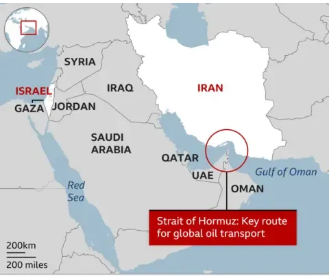
The Strait of Hormuz, a narrow waterway between Iran and Oman connecting the Persian Gulf to the Gulf of Oman and the Arabian Sea, is the world's most important oil transit chokepoint as designated by the US Energy Information Administration (EIA).
| Commodity | Volume / Share |
| Crude Oil | ~15 million barrels per day (~20% of global consumption) |
| LNG (Natural Gas) | ~20% of global LNG trade |
| Risk if Blocked (non-Iranian flows) | 9 million bpd (9% of global demand) structurally at risk |
In addition to Iran, major Gulf oil producers including Saudi Arabia, Iraq, the UAE, and Kuwait are heavily dependent on the Strait to export their oil, making any disruption a global economic event. While limited pipeline bypass capacity exists in the Gulf states, even at full utilisation, approximately 9 million bpd — representing 9% of global demand — would remain structurally at risk during a major escalation.
Oil Price Scenarios — What Lies Ahead?
According to projections by Clayton Seigle of the Center for Strategic and International Studies (CSIS), four primary oil supply disruption scenarios have been identified, each carrying distinct price implications.
Scenario 1 - Disruption of Iranian Oil Shipments (+$10-12 per barrel)
- If Iranian oil shipments are disrupted, global oil prices could rise by $10-12 per barrel.
- China, which buys most of Iran's oil, would need to seek approximately 1.6 million barrels per day from alternative sources.
- This sudden shift in demand would push up global oil prices.
Scenario 2 - Iran Throttles the Strait of Hormuz (Spike beyond $90 per barrel)
- If Iran disrupts up to 18 million barrels per day of non-Iranian Gulf flows through the Strait of Hormuz, prices could spike beyond $90 per barrel.
- This would not only affect Iran's own exports but would also choke off supply from Saudi Arabia, Iraq, the UAE, and Kuwait.
- The entire Persian Gulf energy corridor would effectively come under threat.
Scenario 3 - Attack on Iranian Oil Infrastructure (Beyond $100 per barrel)
- If the US or Israel directly attack Iranian oil infrastructure such as platforms, refineries, and terminals, prices could cross $100 per barrel.
- Such strikes would keep Iranian oil off the global market for a prolonged period.
- This scenario also significantly raises the risk of further regional escalation.
Scenario 4 - Iran Attacks Arab Gulf Oil Facilities (Beyond $130 per barrel)
- This is the most severe scenario. If Iran directly attacks oil facilities in Saudi Arabia and the UAE, prices could exceed $130 per barrel.
- This would surpass even the historic peak witnessed after Russia's invasion of Ukraine in 2022.
- It would drag the entire Gulf region into open conflict, with devastating consequences for global energy supply.
India's Strategic Concerns
India, as the world's third-largest oil consumer and a nation that imports over 88% of its crude requirements, finds itself acutely vulnerable to developments in the Persian Gulf. The stakes for New Delhi are both economic and strategic.
Economic Vulnerability
- India imports approximately 2 billion barrels of oil annually.
- Every $1 increase in oil prices translates to roughly $2 billion in additional annual import expenditure.
- More than 40% of India's crude oil imports transit the Strait of Hormuz, making the chokepoint central to India's energy security.
- A sustained oil price spike could widen India's Current Account Deficit (CAD), depreciate the rupee, and fuel inflation—particularly in fuel, transport, and food sectors.
Strategic and Diplomatic Considerations
- India maintains diplomatic relations with both Iran and the United States, and has historically pursued a policy of strategic autonomy in West Asian affairs.
- New Delhi imports oil from Iran under special arrangements. Any disruption to Iranian supply would require India to rapidly seek alternatives from Saudi Arabia, Iraq, and the UAE — potentially at higher cost.
- India's large diaspora in the Gulf region (over 8 million) and significant remittance inflows add another layer of vulnerability in a regional conflict scenario.
- Indian nationals and assets operating in or near the Persian Gulf could face safety risks if the conflict escalates.
- India has strategic interests in the Chabahar Port in Iran, which serves as a key connectivity project to Central Asia and Afghanistan. Military conflict could jeopardise this
Way Forward
- India must immediately activate its Strategic Petroleum Reserves (SPR) at Visakhapatnam, Mangalore, and Padur to cushion any sudden oil supply shock arising from the conflict.
- India should diversify its crude oil imports by increasing purchases from Russia, the US, and West African nations to reduce over-dependence on Gulf supply routes, particularly the Strait of Hormuz.
- On the diplomatic front, India must engage in proactive back-channel diplomacy with Iran, the Gulf states, and the US to protect its energy supply lines, diaspora interests, and the Chabahar Port investment.
- India should use multilateral platforms such as the United Nations, G20, and SCO to advocate for de-escalation and urge all parties to avoid actions that could disrupt global energy flows.
- In the long term, India must accelerate its transition to renewable energy — solar, wind, and green hydrogen — and fast-track its electric vehicle ecosystem to structurally reduce dependence on imported oil and build lasting energy security.
UPSC Syllabus- GS 2- Effect of policies and politics of developed and developing countries on India's interests, Indian diaspora.
Source- IE

Author: Lemo
Lemo is the founder of Epoch IAS - a UPSC platform built not in classrooms, but at 2 AM over black coffee. He writes notes that are sharp, syllabus-ahead, and made for aspirants who are serious about cracking it. No fluff. Just focus.
Feel free to use images in our website by simply providing a source link to the page they are taken from.
-- Epoch IAS
Explore By Category
Latest Posts
 18th May 2026
![[Download PDF] Union Budget 2026–27 Summary](/storage/blog/small/download-pdf-union-budget-2026-27-summary.jpg) 30th Apr 2026
30th Apr 2026
 20th Mar 2026
 19th Mar 2026
 19th Mar 2026
-development-scheme.jpg) 19th Mar 2026
19th Mar 2026
 19th Mar 2026
 18th Mar 2026
 18th Mar 2026
 18th Mar 2026
 17th Mar 2026
 17th Mar 2026
 17th Mar 2026
 17th Mar 2026
 17th Mar 2026
Share views on Israel-US Strike on Iran: How It Threatens the Strait of Hormuz and India's Energy Security
Please keep your views respectful and not include any anchors, promotional content or obscene words in them. Such comments will be definitely removed and your IP be blocked for future purpose.