C. Rajagopalachari
24th Feb 2026
Read
- Share With Friend & Family
-

-

-

-

-

-

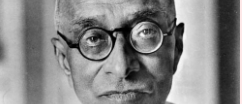
TABLE OF CONTENTS
- Aboout C. Rajagopalachari
News- On February 22, Prime Minister Narendra Modi announced that the statue of British architect Edwin Lutyens in the central courtyard of Rashtrapati Bhavan will be replaced with a statue of C. Rajagopalachari
Aboout C. Rajagopalachari
- Full Name: Chakravarti Rajagopalachari - though the nation fondly knew him as Rajaji or simply C.R.
- Born: December 1878, in Thorapalli village of the Madras Presidency (present-day Tamil Nadu), into a Tamil Brahmin family.
- Gandhi's 'Conscience Keeper': A close associate of Mahatma Gandhi, who deeply trusted his moral clarity and judgment.
- Early Freedom Fighter: He actively participated in the Rowlatt Satyagraha (1919) and later gave up his flourishing legal career to join the Non-Cooperation Movement (1920).
- Salt Satyagraha in the South: In 1930, while Gandhi marched to Dandi, Rajaji led the parallel Vedaranyam Salt March in South India.
- Premier of Madras (1937-39): After Congress formed governments under the Government of India Act, 1935, Rajaji headed the Madras Presidency.
- The Rajaji Formula (1944): In a bold attempt to prevent further division, he proposed a compromise between Congress and the Muslim League, including a plebiscite in Muslim-majority areas. He directly communicated this proposal to Muhammad Ali Jinnah.
- Only Indian Governor-General (1948-1950): After Independence, he succeeded Lord Mountbatten, becoming the only Indian to hold the post before India became a Republic.
- Union Home Minister (1950-51): Served in the cabinet of Jawaharlal Nehru during the early years of independent India.
- Chief Minister of Madras State (1952-54): Continued shaping policy in post-independence India at the state level.
- Temple Entry Reformer: Played a major role in enabling Dalits to enter temples in the Madras Presidency through the Temple Entry legislation (1939).
- Hindi Debate: Though he introduced compulsory Hindi in schools in 1938, he later opposed the imposition of Hindi as India's sole official language during the 1965 language controversy.
- Founder of Swatantra Party (1959): Broke away from Congress ideology to form a party advocating free enterprise, limited government, and opposition to excessive state control.
- Bharat Ratna (1954): Among the first recipients of India's highest civilian honour, recognising his immense contribution to the nation.
Source- IE

Author: Lemo
Lemo is the founder of Epoch IAS - a UPSC platform built not in classrooms, but at 2 AM over black coffee. He writes notes that are sharp, syllabus-ahead, and made for aspirants who are serious about cracking it. No fluff. Just focus.
Feel free to use images in our website by simply providing a source link to the page they are taken from.
-- Epoch IAS
Explore By Category
- Polity and Governance
- Important Bills and Acts
- International Relations
- International Organisations
- Places in News
- Indian Economy
- Environment
- Geography
- Species in News
- Protected Areas in News
- Science & Technology
- Government Schemes & Programmes
- History and Art & Culture
- Miscellaneous
- Index & Reports
- Defence Exercises
- Security
Latest Posts
 18th May 2026
![[Download PDF] Union Budget 2026–27 Summary](/storage/blog/small/download-pdf-union-budget-2026-27-summary.jpg) 30th Apr 2026
30th Apr 2026
 20th Mar 2026
 19th Mar 2026
 19th Mar 2026
-development-scheme.jpg) 19th Mar 2026
19th Mar 2026
 19th Mar 2026
 18th Mar 2026
 18th Mar 2026
 18th Mar 2026
 17th Mar 2026
 17th Mar 2026
 17th Mar 2026
 17th Mar 2026
 17th Mar 2026
Share views on C. Rajagopalachari
Please keep your views respectful and not include any anchors, promotional content or obscene words in them. Such comments will be definitely removed and your IP be blocked for future purpose.