India’s new GDP series
2nd Mar 2026
Read
- Share With Friend & Family
-

-

-

-

-

-

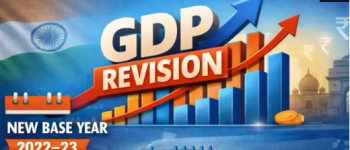
TABLE OF CONTENTS
- Key Improvements in India's New Gross Domestic Product (GDP) Series
- Growth Estimates Under the New Series
Why in News- India has introduced a new GDP series by revising the base year to 2022-23 from 2011-12. The revision incorporates updated data sources, improved methodologies, and structural changes in the economy to present a more accurate picture of national income.
| What is a Base Year?
|
| How is GDP Calculated in India? India estimates GDP using two approaches: 1. Factor Cost (Production) Method Measures Gross Value Added (GVA) across eight major sectors including agriculture, manufacturing, trade, financial services, etc. Evaluates output performance of different industries. 2. Expenditure Method GDP = C + I + G + (X - M)
GDP data is compiled by the Central Statistics Office (CSO) under the Ministry of Statistics and Programme Implementation (MoSPI).
|
Key Improvements in India's New Gross Domestic Product (GDP) Series
1. Revision of Base Year (2011-12 to 2022-23)- The base year has been updated to 2022-23 to reflect the current structure of the economy, technological advancements, and evolving consumption patterns, thereby improving the accuracy of real Gross Domestic Product (GDP) growth measurement.
2. Improved Measurement of the Private Corporate Sector- Instead of assigning the entire Gross Value Added (GVA) of a company to one dominant sector, the new method distributes output according to activity-wise revenue share, providing a more accurate estimate of sectoral contribution.
3. Better Coverage of the Unincorporated and Household Sector- The new framework uses annual data from the Annual Survey of Unincorporated Sector Enterprises (ASUSE) and the Periodic Labour Force Survey (PLFS) for direct estimation, improving measurement of informal enterprises, self-employed workers, and household Gross Fixed Capital Formation (GFCF).
4. Stronger Estimation of the Government Sector- The revised methodology includes housing services provided to government employees and improves coverage of autonomous bodies and local governments, leading to more comprehensive measurement of government output.
5. Improved Estimation of Private Final Consumption Expenditure (PFCE)- Consumption is now measured using the Classification of Individual Consumption According to Purpose (COICOP) 2018 along with household consumer expenditure surveys, production data, and administrative datasets, resulting in a more accurate estimate of domestic demand.
6. Greater Use of Goods and Services Tax (GST) and Administrative Data- Expanded integration of Goods and Services Tax (GST) data enhances estimation of regional output, corporate value addition, and identification of active companies, thereby reducing estimation errors and better capturing formal economic activity.
7. Financial Sector Methodological Upgrade- The banking sector is estimated using the Statistical Tables Relating to Banks in India (STRBI) published by the Reserve Bank of India (RBI), and Non-Banking Financial Companies (NBFCs) are measured using actual financial data from the Ministry of Corporate Affairs, improving financial sector Gross Value Added (GVA) estimates.
8. Adoption of Double Deflation Method- The new series applies separate price adjustments to inputs and outputs in sectors such as agriculture and manufacturing, replacing the earlier single deflator method and resulting in more accurate real growth estimation.
9. Integration with Supply and Use Tables (SUT)- The integration of Supply and Use Tables (SUT) into national accounts ensures better alignment between production and expenditure approaches, reduces statistical discrepancies, and improves overall consistency in Gross Domestic Product (GDP) estimation.
Growth Estimates Under the New Series
According to the revised estimates reflected in the data:
- Real GDP Growth (FY 2025-26): 7.6%
- Nominal GDP Growth: 8.6%
- Q2 Growth: 8.4%
- Q3 Growth: 7.8%
Source- PIB

Author: Lemo
Lemo is the founder of Epoch IAS - a UPSC platform built not in classrooms, but at 2 AM over black coffee. He writes notes that are sharp, syllabus-ahead, and made for aspirants who are serious about cracking it. No fluff. Just focus.
Feel free to use images in our website by simply providing a source link to the page they are taken from.
-- Epoch IAS
Explore By Category
- Polity and Governance
- Important Bills and Acts
- International Relations
- International Organisations
- Places in News
- Indian Economy
- Environment
- Geography
- Species in News
- Protected Areas in News
- Science & Technology
- Government Schemes & Programmes
- History and Art & Culture
- Miscellaneous
- Index & Reports
- Defence Exercises
- Security
Latest Posts
 18th May 2026
![[Download PDF] Union Budget 2026–27 Summary](/storage/blog/small/download-pdf-union-budget-2026-27-summary.jpg) 30th Apr 2026
30th Apr 2026
 20th Mar 2026
 19th Mar 2026
 19th Mar 2026
-development-scheme.jpg) 19th Mar 2026
19th Mar 2026
 19th Mar 2026
 18th Mar 2026
 18th Mar 2026
 18th Mar 2026
 17th Mar 2026
 17th Mar 2026
 17th Mar 2026
 17th Mar 2026
 17th Mar 2026
Share views on India’s new GDP series
Please keep your views respectful and not include any anchors, promotional content or obscene words in them. Such comments will be definitely removed and your IP be blocked for future purpose.